

If you're seeking testosterone replacement therapy, you have two primary paths: visiting a local clinic in person or working with an online TRT clinic. Both options give patients access to medically supervised treatment, but they differ in convenience, cost, and the level of hands-on support you receive. The right choice depends on your health history, goals, and how much direct medical oversight you want throughout treatment.
What Is TRT and Who Needs It?
Testosterone replacement therapy addresses clinically low testosterone levels, a condition the American Urological Association (2018) defines as total serum testosterone below 300 ng/dL with accompanying symptoms. Common symptoms include persistent fatigue, reduced muscle mass, low libido, mood changes, cognitive fog, and difficulty with recovery after exercise.
TRT is not a lifestyle supplement for healthy men. It is a medical treatment prescribed only after blood panel confirmation, symptom review, and a physician-led evaluation. Any clinic, online or in-person, should follow this clinical protocol before initiating testosterone therapy. Patients seeking treatment should expect a thorough intake process, not a quick approval.
The number of men seeking TRT has grown substantially. According to research published in JAMA Internal Medicine (2013), testosterone prescriptions in the United States tripled between 2001 and 2011. The expansion of online TRT clinics has accelerated access further, giving patients more options than ever before.
Online TRT Clinics: Access From Anywhere
Online trt clinics have expanded patient access to testosterone replacement significantly over the last several years. Patients in remote areas or those with demanding schedules can now receive a complete treatment plan, lab orders, and medication delivery without leaving home. The rise of telehealth has made online trt a genuine medical option rather than a workaround.
How Online TRT Works
The process at most online trt clinic platforms follows a structured sequence designed to replicate the clinical rigor of in-person care:
- Initial intake: You complete a health questionnaire and symptom assessment on the clinic's platform.
- Lab work: The clinic orders bloodwork at a nearby lab facility or sends an at-home collection kit.
- Physician review: A licensed physician reviews your labs and medical history before any prescription is written.
- Treatment plan: If you qualify medically, you receive a personalized treatment plan with dosing instructions, frequency, and monitoring requirements.
- Medication delivery: Testosterone (typically cypionate or enanthate) ships directly to your address.
- Ongoing monitoring: Follow-up labs at regular intervals ensure your testosterone levels stay within the therapeutic range and that secondary markers like hematocrit and PSA remain safe.
Benefits of Online TRT Clinics
Online trt clinics have earned a legitimate place in the healthcare landscape because they remove barriers that previously stopped many patients from seeking care:
- Convenience: No waiting rooms, no commutes. Patients manage their entire care experience from home, with most communication handled through a secure patient portal.
- Access: Online TRT clinics serve patients across multiple states, including San Diego, Denver, and beyond. Patients in areas without a local testosterone clinic now have a path to treatment.
- Cost efficiency: Digital-first clinic models carry lower overhead, which can result in more affordable care for patients who are paying out of pocket.
- Consistent follow-up: Many platforms use automated lab reminders and secure messaging to keep patients on schedule with monitoring and check-ins, ensuring continuity that reduces lapses in care.
- Privacy: Some patients prefer the discretion of receiving treatment without visiting a physical clinic.
Limitations of Online TRT
Online trt clinics provide strong access and support, but there are clinical limitations worth understanding before committing to a remote-only model:
- Physical examinations are not possible through a screen. If your provider suspects a secondary condition contributing to low testosterone, such as a pituitary disorder or testicular abnormality, you will need an in-person referral for further evaluation.
- Injections require self-administration or assistance from a local medical professional. Not all patients are comfortable with this, and technique matters for consistent dosing and safety.
- Shipping delays can interrupt treatment cycles if orders are not planned carefully. A missed injection window affects hormone stability.
- Patients with complex health histories, including cardiovascular conditions, prostate concerns, or polycythemia, may not be appropriate candidates for remote-only management.
Explore AH Clinics testosterone therapy services in San Diego
In-Person TRT Clinics in San Diego: Hands-On Medical Support
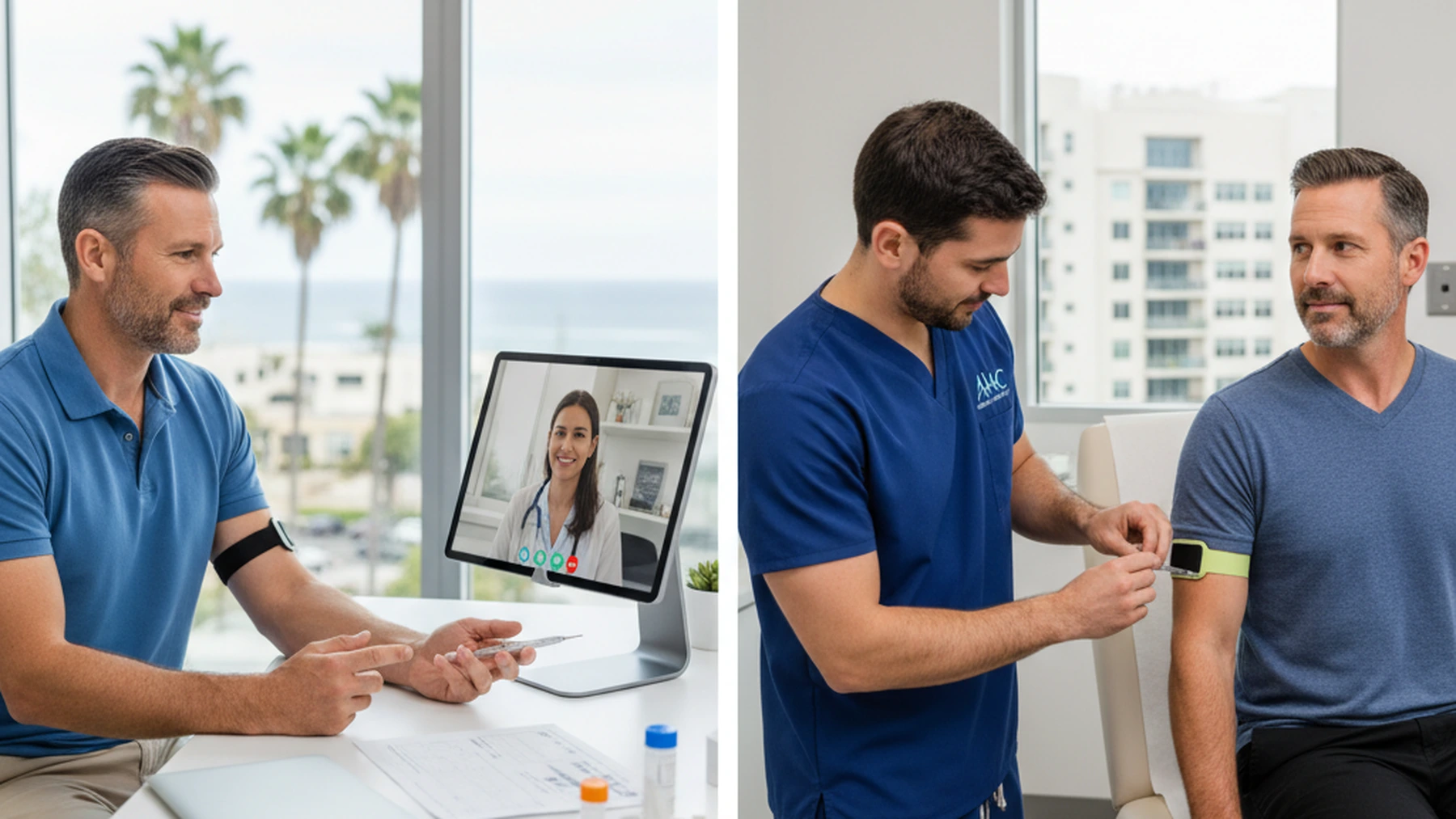
In-person testosterone clinics like AH Clinics in San Diego provide a clinical environment where a medical team can perform full evaluations, administer injections, and monitor your response to treatment in real time. This level of direct oversight is particularly valuable for patients who are new to testosterone replacement therapy, who have complex health histories, or who simply prefer a provider they can see and speak with directly.
What In-Person Care Provides
Comprehensive physical exams: Providers assess overall health, evaluate physical signs of hormonal imbalance, and identify conditions that bloodwork alone cannot capture. A thorough physical exam is the foundation of responsible testosterone clinic care.
On-site injections: Patients who prefer clinic-administered injections avoid the learning curve of self-injection entirely. For patients who are nervous about self-injection or who want to ensure proper technique, on-site administration is a significant advantage.
Immediate clinical adjustments: If side effects emerge, or if lab values shift unexpectedly, your provider can adjust your treatment plan during the same visit. This real-time responsiveness is one of the clearest advantages of in-person clinical care.
Coordinated, integrated care: In-person clinics can combine testosterone replacement with other services under one medical team. At AH Clinics, patients can pair TRT with hormone replacement therapy, peptide therapy, or medical weight loss as part of a broader health optimization strategy. This integrated approach means your providers are seeing the full picture of your health, not just one data point.
The Value of Local Expertise
San Diego patients benefit from working with providers who understand regional health trends, local lab networks, and California-specific prescribing standards. AH Clinics brings this local knowledge together with a clinical team experienced in men's hormone optimization, ensuring that treatment plans are grounded in both medical evidence and the practical realities of patient life in the region.
Building a relationship with a local medical team also creates accountability on both sides. Providers who see patients regularly develop a richer clinical picture over time, which makes dosing adjustments and monitoring more precise.
Online vs In-Person TRT: Side-by-Side Comparison
| Factor | Online TRT Clinic | In-Person TRT Clinic |
|---|---|---|
| Convenience | High, no travel required | Moderate, scheduled appointments |
| Physical exam | Not available | Available |
| Lab monitoring | Ordered remotely | On-site or coordinated locally |
| Injection support | Self-administered | Clinic-administered option |
| Integrated care | Limited | Full care coordination |
| Availability | Nationwide, multi-state | Local, relationship-based |
| Best suited for | Stable, self-sufficient patients | New patients, complex cases, full care |
How to Choose the Right TRT Clinic
The right choice depends on your health complexity, your comfort with self-management, and how much hands-on support you want from your medical team. Both online trt and in-person care are legitimate pathways to testosterone replacement therapy when administered by qualified providers following evidence-based protocols.
Choose online TRT if:
- You are comfortable with self-injection and routine self-monitoring
- Your health history is straightforward with no significant complicating conditions
- You live far from a quality clinic or have scheduling limitations that make regular visits impractical
- You have received TRT before and need ongoing maintenance management
Choose in-person TRT if:
- You are starting testosterone therapy for the first time and want direct physician guidance
- You have cardiovascular risk factors, prostate concerns, elevated hematocrit, or other conditions that require closer clinical monitoring
- You prefer a physician who can examine you, adjust your treatment in person, and coordinate with your other providers
- You want a comprehensive care plan that integrates hormones, metabolic health, and wellness under one clinical roof
For patients in San Diego, in-person care with AH Clinics means your treatment is never just a form submission. It means a medical team that knows your history, monitors your progress, and adjusts your plan as your health evolves.
What Patients Should Know Before Starting TRT
Before any testosterone clinic, online or in-person, initiates treatment, certain clinical steps are non-negotiable. Patients should verify that any clinic they are considering follows these standards.
Required baseline labs include:
- Total and free testosterone (confirmed on at least two separate morning draws)
- Luteinizing hormone (LH) and follicle-stimulating hormone (FSH)
- Complete blood count (CBC)
- Comprehensive metabolic panel (CMP)
- Prostate-specific antigen (PSA) for patients over 40
- Hematocrit and hemoglobin
The Endocrine Society Clinical Practice Guidelines (2018) recommend confirming low testosterone with at least two separate morning blood draws before initiating treatment. Any clinic skipping this step is not following evidence-based medical standards, and patients should treat this as a red flag.
Ongoing monitoring is required throughout treatment. The same Endocrine Society guidelines recommend repeating labs at 3 months after starting TRT, then every 6 to 12 months once levels stabilize. Your clinic must build this monitoring cadence into your treatment plan from the beginning. Labs are not optional and should not be left to the patient to self-manage without clinical guidance.
Realistic expectations matter. Most patients report meaningful improvements in energy, mood, and motivation within 3 to 6 weeks of starting testosterone replacement therapy. Changes to body composition, muscle mass, and libido typically develop over 3 to 6 months of consistent, monitored treatment.
AH Clinics: San Diego's Testosterone Therapy Resource
AH Clinics offers medically supervised testosterone replacement therapy in San Diego with a clinical team that combines diagnostic precision with individualized care. Whether you are exploring TRT for the first time or transferring from another online trt clinic or provider, the process starts with a thorough evaluation designed to match treatment to your biology and health history, not a one-size-fits-all protocol.
The AH Clinics team supports patients through every phase of treatment: initial lab evaluation, dosing, monitoring, and ongoing optimization as your body responds over time. For patients who need more than testosterone replacement, AH Clinics coordinates care across hormone health, peptide therapies, and metabolic wellness, keeping all aspects of your treatment under one clinical team that communicates in real time.
Book a consultation with AH Clinics today to discuss whether TRT is the right fit for your health goals and get a comprehensive evaluation from a team that treats the whole patient, not just the number on a lab report.
You can also reach the team directly at the AH Clinics contact page.
Frequently Asked Questions
Is online TRT as safe as in-person testosterone replacement therapy?
Online TRT can be medically safe when provided by a licensed physician who orders proper baseline labs, confirms the diagnosis through clinical criteria, and schedules ongoing monitoring at defined intervals. The safety risk with any TRT provider, online or in-person, arises when labs are skipped, monitoring is inadequate, or dosing is not adjusted based on lab feedback. Patients should verify that any online trt clinic requires bloodwork before prescribing and includes mandatory follow-up lab reviews.
Can I switch from an online TRT clinic to an in-person clinic?
Yes. Patients can transfer care at any time. You will typically need to bring recent lab results and your current treatment protocol to the new provider. An in-person clinic like AH Clinics can review your existing treatment plan, perform a physical evaluation, and continue or adjust your therapy based on current clinical data. Transfer patients are welcome, and AH Clinics will not ask you to restart from zero if your prior documentation is complete.
What forms of testosterone are used in TRT treatment plans?
The most common forms are testosterone cypionate and testosterone enanthate, both administered by intramuscular or subcutaneous injection. Topical testosterone gels and creams are also prescribed for patients who prefer to avoid injections. Injections remain the standard for most treatment plans due to their predictable absorption and dosing control, but the right delivery method depends on the individual patient's needs and preferences.
How long before I feel results from testosterone replacement therapy?
Most patients report initial improvements in energy and mood within 3 to 6 weeks of starting TRT. Libido and sexual function typically respond within the same 3 to 6 week window. Muscle composition, body fat redistribution, and strength changes take longer and are generally measurable after 3 to 6 months of consistent, monitored treatment. Individual results vary based on baseline testosterone levels, dosing accuracy, lifestyle factors, and how consistently labs and follow-ups are maintained.
Does AH Clinics accept patients who have been on testosterone therapy at another clinic?
Yes. AH Clinics accepts transfer patients from other providers, including patients who have been managed by an online TRT clinic and are now seeking in-person support. The team will review prior labs and treatment history, perform a current evaluation, and build a treatment plan that reflects your current health status. Contact AH Clinics to discuss your transfer options and schedule your first appointment.