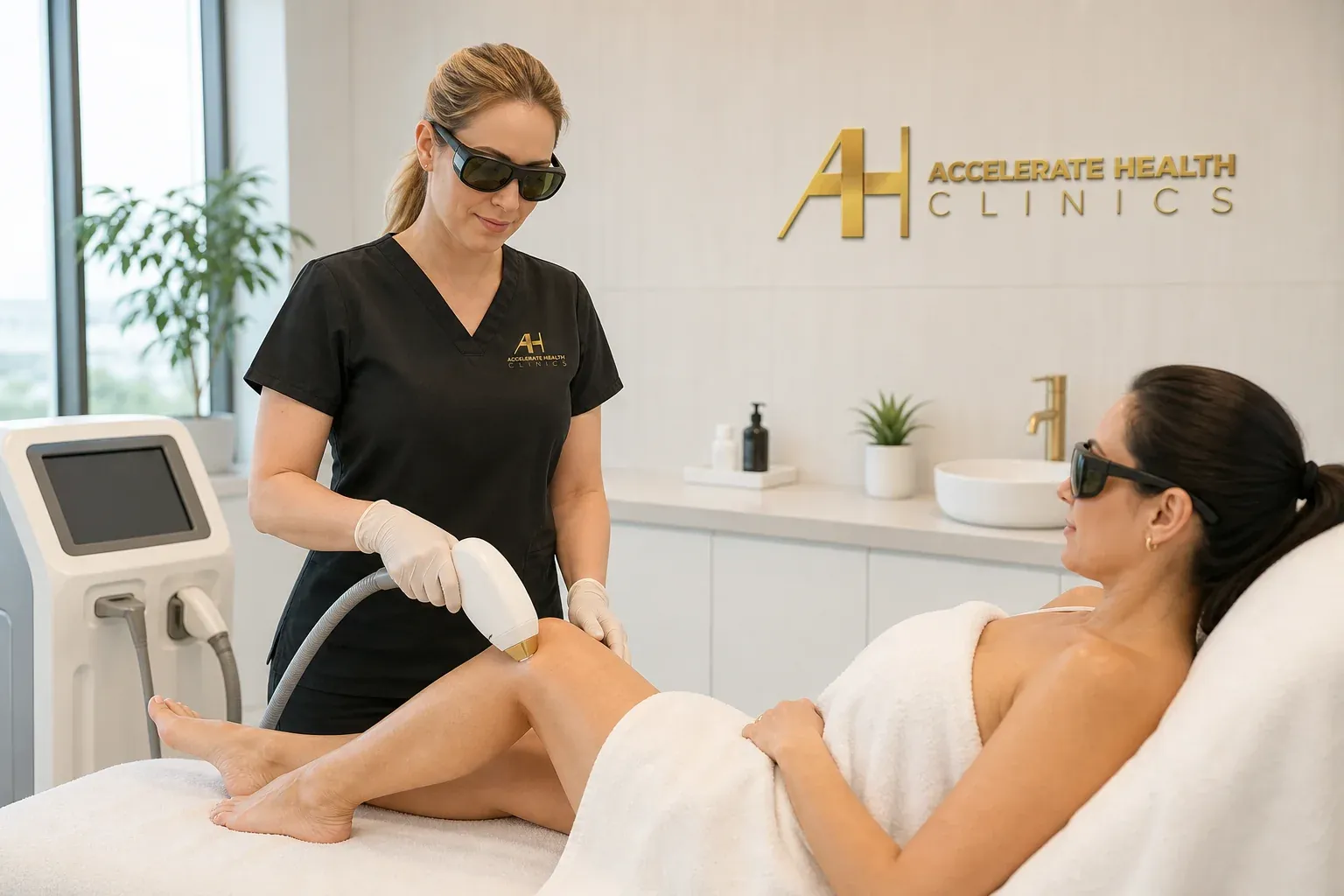
Not every provider offering laser treatments operates under the same rules. Choosing between a med spa or medical clinic for laser hair removal services comes down to one question: who is legally allowed to operate the laser on your skin. Understanding that difference before you Book Now protects both your results and your safety.
A med spa and a medical clinic can offer the exact same laser hair removal device and services, sit two miles apart, and still operate under completely different oversight. A medical clinic is built around a physician's practice: the doctor is the owner or the on-site clinical authority, and every treatment plan runs through that license. A med spa, sometimes called a medical spa, is a hybrid business model.
It blends spa-style amenities with medical treatments, but it must still operate under a licensed medical director who is legally responsible for what happens with the laser. Many medspas market themselves this way, but the legal responsibility doesn't change with the branding. The real question when comparing a med spa or medical clinic for laser hair removal isn't which one looks nicer.
It's who signs off on your treatment plan, who trains the technician, and who's accountable if something goes wrong. That accountability chain matters more for a laser, an actual medical device, than it does for a facial or a skin care service that doesn't touch living tissue with concentrated light energy.
That distinction is exactly why the question deserves more attention than most people give it before booking their first appointment.
Who Is Legally Allowed to Operate a Laser Hair Removal Device?
The FDA classifies hair removal lasers as medical devices, which means their use isn't left to personal judgment. Who can legally operate one is determined by each state's medical board, and the rules vary more than most patients expect.
In many states, a physician, physician assistant, or nurse practitioner can operate the laser directly, or a specially trained and certified laser technician can operate it under a physician's supervision.
Estheticians may be permitted to assist or perform certain treatments depending on the state, but usually only within a defined scope and under medical oversight, never independently diagnosing skin conditions or adjusting settings without training.
This is not a minor technicality: operating a laser without the legally required training or supervision can result in disciplinary action against the practice and, more importantly, an increased risk of injury to the patient. Because these rules differ by state, the safest approach is to ask directly: who is the medical director, and who is physically running this laser today.
A provider confident in their answer usually has nothing to hide.
Is It Safe to Get Laser Hair Removal at a Med Spa?
Laser hair removal at a med spa can be just as safe as at a medical clinic, provided the medical spa maintains real physician oversight rather than a name on a wall. Safety comes down to three things: proper patient screening for skin type, medication history, and recent sun exposure, correctly calibrated settings for that patient's skin, and a trained operator who knows how to adjust for complications in real time.
The risk shows up when a med spa treats the medical director role as a formality instead of an active responsibility. The same standard applies to other in-office services; even a routine Botox or body contouring appointment depends on that same chain of medical accountability, not just a friendly front desk.
Does a Doctor Have to Be On-Site During Laser Hair Removal Treatment?
This depends on the state and, in some cases, on the specific type of laser being used. Some states require the supervising physician to be physically on-site during treatment sessions. Others allow off-site or on-call supervision, where the physician is reachable but not in the building.
Neither model is inherently unsafe when the supervising structure is followed correctly, but a patient has every right to ask which model a given practice uses before booking. If a med spa can't clearly explain its supervision structure, that's a signal to ask more questions, not to assume the strictest possible standard is automatically in place.
What Credentials or Licenses Should You Check Before Booking Laser Hair Removal?
Before your first laser hair removal session, it's reasonable to ask a provider for specifics rather than reassurance.
Useful questions include: who is the medical director, and are they licensed in this state? Is the technician certified specifically in laser operation, not just general esthetics? Does the practice carry medical malpractice or professional liability coverage? Is there a documented consultation process that screens for skin type, medications, and prior reactions before the first session? It's also worth checking the practice's Google reviews for patterns in how patients describe their results and any complications.
The best med spas and medical clinics answer these questions clearly and often have this information posted or available on request. Hesitation or vague answers are worth treating as a real warning sign, not an oversight.
What Happens if a Laser Hair Removal Treatment Causes a Burn or Other Complication?
Even with correct technique, laser treatments carry some risk of burns, blistering, or temporary hyperpigmentation, especially on tanned or darker skin tones treated with the wrong settings. What separates a well-run practice isn't the absence of risk, it's how a complication is handled.
A physician-directed clinic typically has a documented protocol: immediate assessment, appropriate wound care, and a follow-up plan, sometimes involving the supervising physician directly. A facility without real medical oversight may have no clear escalation path at all, leaving a patient to seek care elsewhere on their own. Ask how complications are handled before you need the answer, not after.
How Do State Laws Regulate Who Can Perform Laser Hair Removal?
State laws on laser hair removal generally fall into a few patterns: physician-only operation, physician-supervised operation by trained non-physicians, or, in a smaller number of states, looser rules with minimal licensing requirements specific to laser devices.
Industry groups such as the American Med Spa Association track this variation closely because it shapes how medical spas can legally staff and structure treatments. Because state medical boards, not federal agencies, enforce most of these rules day to day, requirements can also change with new legislation.
Patients who ask about a provider's current licensing status, rather than assuming it hasn't changed since a friend's recommendation, protect themselves against outdated information. A practice that stays current on its state's requirements is generally the one worth trusting with a device that touches your skin directly.
Frequently Asked Questions
Can an esthetician legally perform laser hair removal?
In some states, yes, but usually only under a physician's supervision and within a defined scope of practice, not independently. Estheticians are trained in skin care and treatments that don't penetrate below the skin's surface, while laser hair removal requires additional certification specific to operating a medical device.
Rules vary significantly by state, so the honest answer depends on where the treatment happens.
Is laser hair removal considered a medical procedure?
Yes. Because it uses a device the FDA classifies as a medical device, and because it carries real risk of burns or skin changes if mishandled, laser hair removal is treated as a medical procedure in most states rather than a purely cosmetic service. That classification is exactly why oversight, licensing, and physician accountability matter as much as the treatment itself.
How can I tell if a med spa is properly licensed for laser treatments?
Ask directly for the name and license of the medical director, confirm the technician's laser-specific certification, and check whether your state's medical board offers a public licensing lookup. A properly licensed medical spa will not hesitate to share this information, and many list it on their website or during the initial consultation.
Are med spas held to the same regulations as medical clinics?
Largely, yes, when it comes to the laser itself. Because the device is medically regulated regardless of setting, a med spa performing laser hair removal is bound by the same core safety and supervision requirements as a medical clinic, even though the surrounding experience may feel more spa-like.
Should I choose a dermatologist's office over a med spa for laser hair removal?
Not necessarily. What matters more than the label on the door is whether the provider has verified physician oversight, proper technician training, and a clear complication protocol. A well-run medical spa with real medical accountability can be just as appropriate a choice as a dermatologist's office for routine laser hair removal sessions.
Schedule Your Laser Hair Removal Consultation at AH Clinics
Choosing between a med spa or medical clinic for laser hair removal services is really a question of who stands behind the treatment plan and the device itself. If you'd like your questions about credentials, supervision, and safety answered directly before your first session, Contact our team to get started.
Wondering whether laser is right for your skin? The consultation is free and you get a quoted price up front.