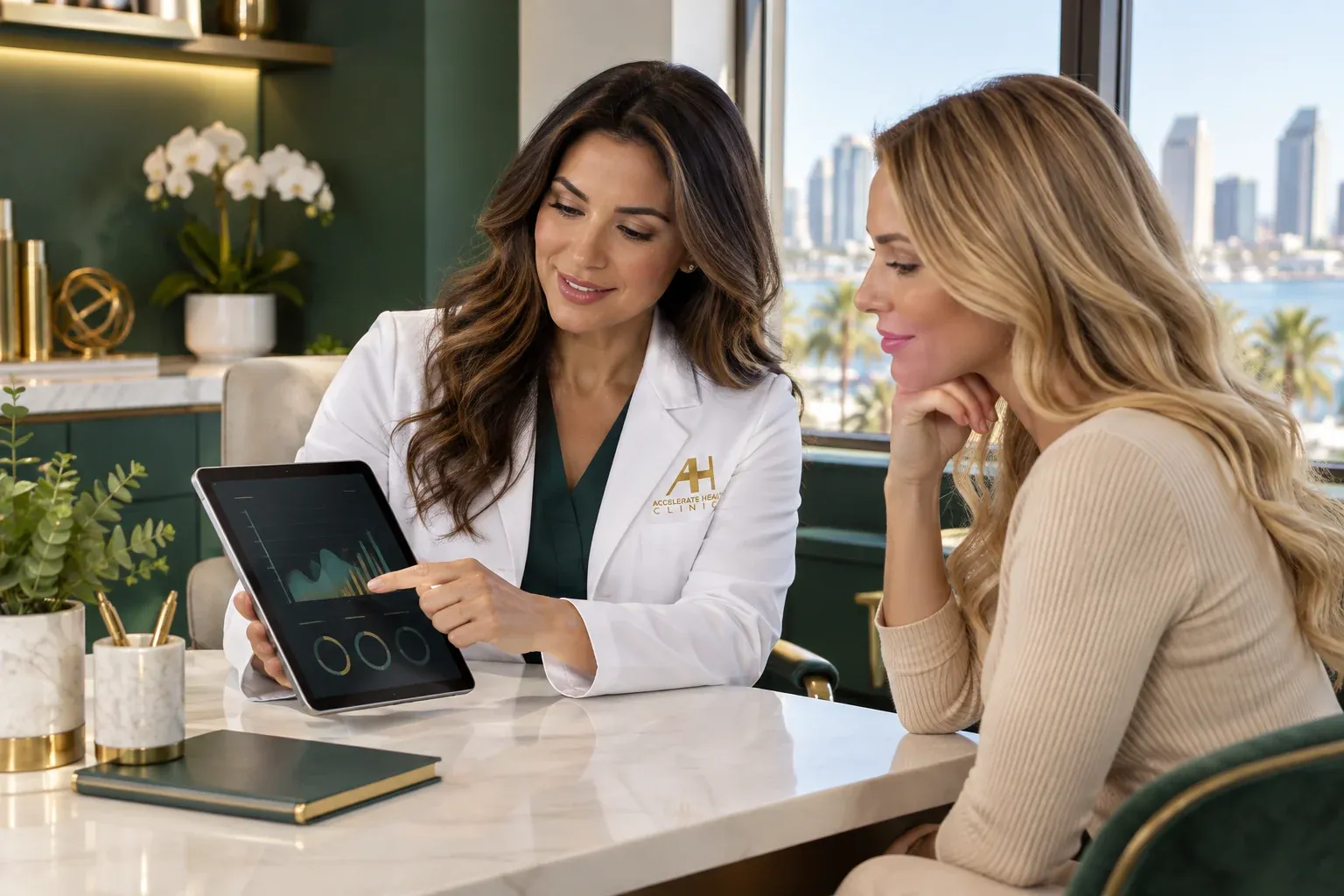
A hair restoration consultation in San Diego is where a licensed provider examines your scalp, evaluates your donor supply, and explains which Hair Restoration approach fits your degree of hair loss and goals. Knowing what that visit covers, and what actually drives cost afterward, helps you walk in prepared and leave with a real plan.
By The Medical Team at Accelerate Health Clinics, Licensed medical providers, San Diego
A hair restoration consultation in San Diego usually opens with a review of your medical history, including any thyroid issues, recent illnesses, medications, or family history of pattern hair loss, since these all influence how a provider approaches treatment.
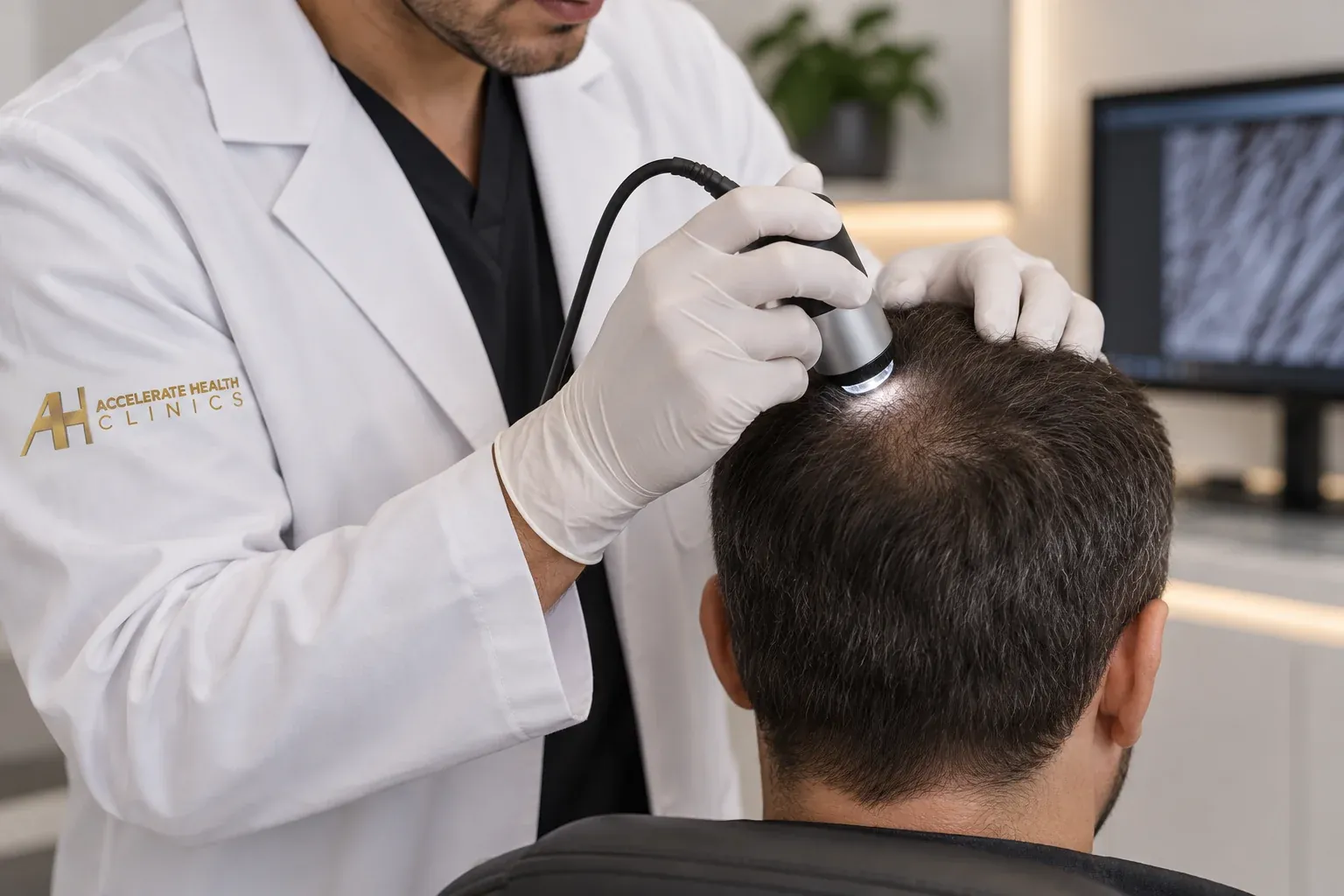
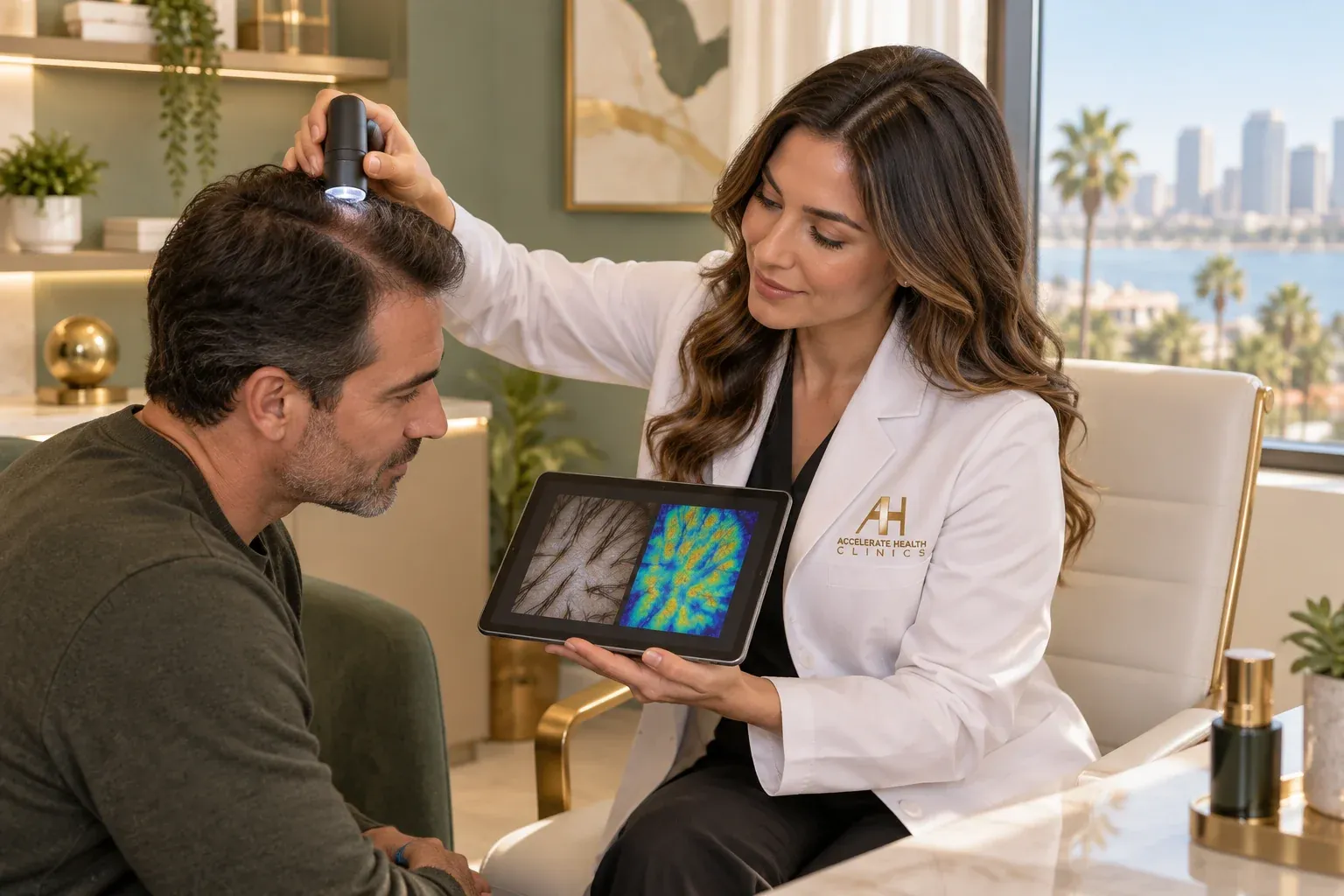
Your provider then examines your scalp under bright light or magnification, mapping the pattern and stage of thinning against a standard classification scale (Norwood for men, Ludwig for women) and checking donor density at the back and sides of the scalp, the area most hair transplants draw from.
Expect a frank conversation about what surgical hair restoration can and cannot achieve for your specific pattern of hair loss. A provider who skips donor evaluation, or who promises a full head of hair regardless of your starting density, is skipping a step that matters.
How Long Does the Consultation Take?
Most hair restoration consultations run about 30 to 60 minutes, though a first visit that includes photography, a scalp exam, and a detailed discussion of technique can run longer. Complex cases, or ones comparing prior hair transplants performed years apart, sometimes need a short follow-up visit to finish the plan.
Can I Get a Virtual Hair Restoration Consultation Before Visiting in Person?
Many clinics offer an initial virtual screening using photos or a video call, which is useful for out-of-area patients deciding whether an in-person visit is worth the trip.
A virtual visit can rule out obvious non-candidates and rough out technique options, but a hands-on scalp exam and donor density check usually still happen in person before a treatment plan is finalized, since density is difficult to judge accurately on camera.
What Questions Should You Ask at a Hair Transplant Consultation?
A provider who answers these clearly, tradeoffs included, is generally easier to trust with a procedure that is difficult to fully undo.
What Should I Bring to My Hair Restoration Consultation?
Bring photos that show your hair loss progression over the last several years if you have them, a list of current medications and supplements, and any prior bloodwork related to thyroid or hormone levels. A written list of your own questions helps too, since consultations move quickly and it is easy to forget one once you are in the chair.
What Determines the Cost of Hair Restoration Treatment?
Hair transplant cost is built from several line items, not one flat number, and understanding each one is more useful than any single quoted figure, since your case will land somewhere different than someone else's, whether that means a touch-up of a few hundred grafts or a multi-session plan approaching 15,000, with most extensive cases still settling well under 10,000 overall. Number of grafts.
The number of grafts your case requires is the single biggest driver of the cost of hair restoration treatment. A hairline touch-up might call for a few hundred follicular unit grafts, while more extensive thinning can require several thousand, and in multi-session cases pursued over a patient's lifetime donor supply, combined totals can range from around 10,000 to as high as 15,000 across scalp and body donor sites.
More grafts generally means more provider time, more equipment use, and a higher total. Technique. Follicular unit extraction is typically more labor-intensive per graft than a strip (FUT) procedure, since each follicular unit is harvested individually rather than removed as a single strip and dissected afterward.
That labor difference usually shows up in the price. Provider expertise and who performs the work. A board-certified surgeon performing extraction and placement personally, versus a largely technician-run process, tends to price differently, and that difference is worth asking about directly.
Sessions needed. Some patients complete their goal in one session; others need a second round months later once healed grafts reveal where more density is still needed. Each additional session is billed as its own procedure.
What is bundled versus billed separately. Anesthesia, post-op medication (finasteride or minoxidil), scalp micropigmentation touch-ups, and follow-up visits are sometimes included in a quoted price and sometimes billed on top of it.
Providers often combine surgical grafting with PRP therapy and medication protocols to slow shedding in the areas surrounding a newly placed hairline, and that combination adds its own separate line to a final estimate.
The most useful question to ask any provider quoting hair transplant cost is what is included in that number and what is not, since a lower quote that excludes medication, anesthesia, or a second session is not actually the lower total.
How Much Does a Hair Restoration Consultation Cost in San Diego?
The consultation itself is usually priced, or not priced, separately from any eventual treatment. Many clinics treat the first visit as an evaluation and education appointment rather than a billable procedure, since no grafting happens that day. Ask directly whether the visit includes imaging, bloodwork, or a scalp biopsy, since any of those can turn a routine consultation into a billed one.
Is the First Hair Restoration Consultation Free in San Diego?
Many providers, though not all, offer the first hair restoration consultation at no charge because it functions primarily as an evaluation rather than a treatment. Whether a follow-up visit, imaging, or bloodwork changes that depends on the clinic, so confirming the policy before you book is worth the extra minute.
Is a Hair Restoration Consultation Covered by Insurance?
Hair restoration is generally classified as cosmetic, so most health plans do not cover the consultation or the procedure itself. An exception can apply when hair loss stems from a documented medical condition, such as alopecia related to an autoimmune disorder or scarring from an injury, in which case a portion of care may be reimbursable.
Providers can often supply documentation, such as clinical notes and photos, that a patient can forward to their insurer for reimbursement consideration; that request usually starts with a quick message through our Contact page.
The questions you ask at a hair transplant consultation shape whether the plan you leave with actually fits your case. Useful ones to bring:
- Which technique, follicular unit extraction (FUE) or a strip method (FUT), fits my donor area and goals, and why
- Roughly how many grafts my case is likely to need, and how that number was estimated
- Who performs the actual graft extraction and placement, a physician or a trained technician
- What the expected timeline looks like, from procedure day through visible growth
- Whether before-and-after photos of patients with a similar hair loss pattern are available to review
- What happens if the results fall short of what was discussed
Getting Started After Your Consultation
How Soon After the Consultation Can Treatment Start?
Timing depends on your case, scheduling availability, and whether any pre-procedure bloodwork or medication clearance is needed first. Some patients schedule their procedure the same day as the consultation; others wait several weeks while lab results come back or a second opinion is sought. Your provider can usually give you a realistic window once your plan is finalized.
Do I Need a Referral to Book a Hair Restoration Consultation in San Diego?
A referral typically is not required to book a hair restoration consultation, since it is a self-referred cosmetic visit much like most aesthetic appointments. If your hair loss appears linked to an underlying medical condition, a referral from a primary care provider or dermatologist can still add useful diagnostic context worth bringing to the visit.
Frequently Asked Questions
What is the difference between FUE and FUT hair transplants?
Follicular unit extraction (FUE) removes individual follicular units one at a time, leaving small dot scars rather than a linear one, while FUT (strip surgery) removes a strip of donor scalp and dissects it into grafts afterward. FUE generally allows more flexibility in graft number per session; FUT can sometimes yield more grafts in a single sitting. Which fits your case is a consultation question, not a rule.
How many grafts do most hair transplants require?
It varies widely by pattern and goal. A hairline refinement might need only a few hundred grafts, while more extensive hair loss can call for several thousand in one session, with some patients pursuing multiple sessions over time that push the combined total well past 10,000. Your provider estimates the number from your donor density and the area being treated.
Can women have a hair restoration consultation too?
Yes. Pattern hair loss in women, often assessed using the Ludwig scale, is a common reason for a consultation, and the exam and cost structure follow the same basic framework as for men, though donor planning and technique choice can differ based on how the thinning is distributed.
What happens if I am not a good candidate for a hair transplant?
A provider may recommend medical management, such as finasteride or minoxidil, PRP therapy, or scalp micropigmentation, instead of surgery if donor density is too low to support grafting or if hair loss is still actively progressing. Ruling out surgery at a consultation is a legitimate outcome, not a wasted visit.
Start Your Hair Restoration Consultation at AH-Clinics
Ready to find out what your donor supply, technique options, and realistic cost structure actually look like? Book Now to schedule a hair restoration consultation with our team in San Diego.
Hair loss is easier to treat early. A free consultation with a licensed provider will tell you where you stand.