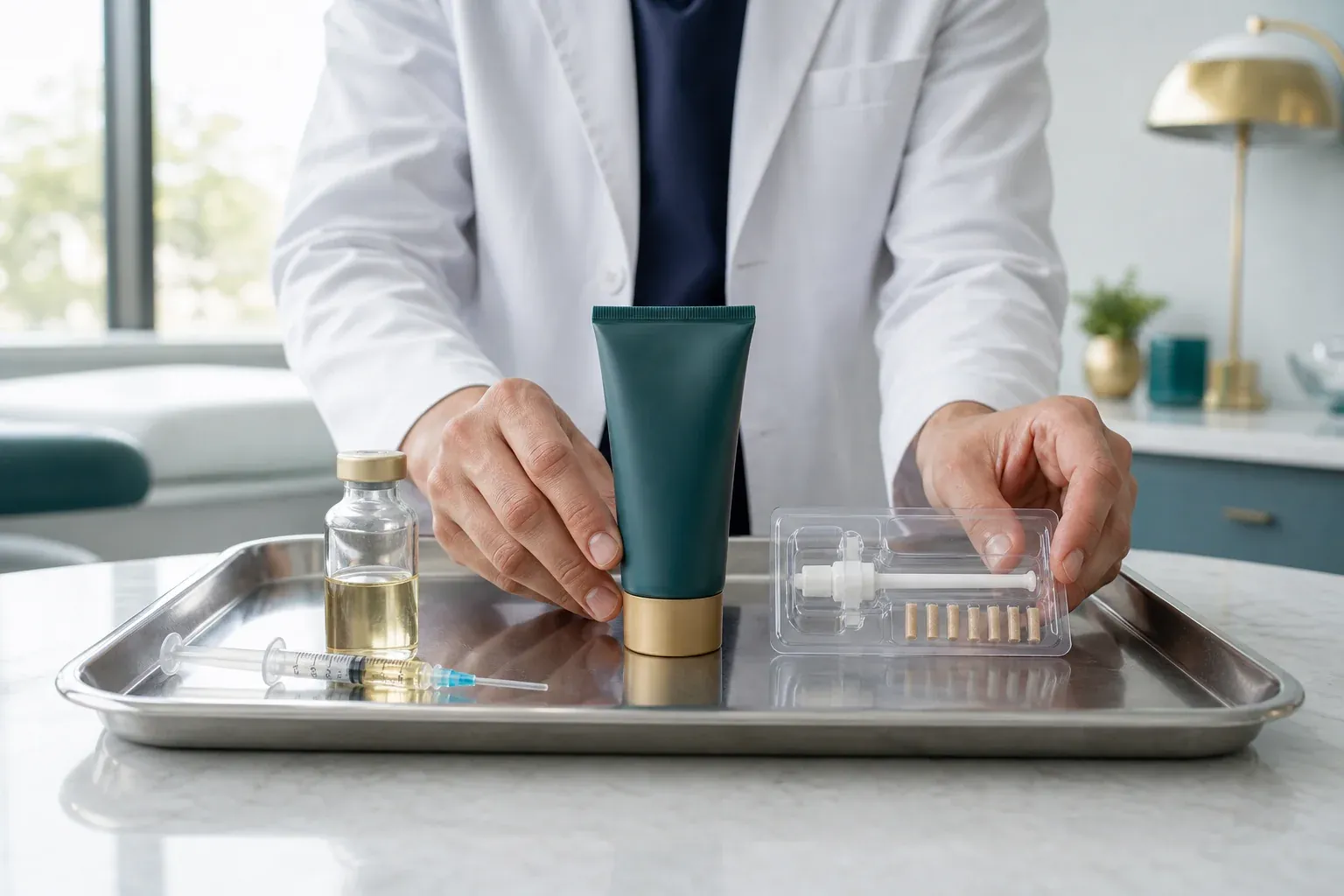

Testosterone therapy and fertility often pull in opposite directions: therapy that resolves fatigue and low sex drive can also shut down natural sperm production. Before starting treatment at a Testosterone Clinic, men who want children, now or later, need a clear picture of what testosterone replacement does to sperm counts and how reversible it is.
By The Medical Team at Accelerate Health Clinics, Licensed medical providers, San Diego
Yes. Because testosterone therapy and fertility depend on the same hormonal signaling pathway, adding testosterone from outside the body naturally interferes with sperm production. The brain reads external testosterone as a sign the body already has enough, and scales back the signals that keep the testicles active.
Protecting male fertility while managing symptoms of low testosterone is possible, but it takes planning before testosterone replacement therapy starts, not after sperm counts have already dropped.
How Long Does It Take to Become Infertile on Testosterone Therapy?
The timeline varies by individual. Many men see sperm counts decline within three to six months of starting testosterone therapy, and some reach azoospermia (zero sperm in the ejaculate) faster than that. Others retain some natural sperm production longer, depending on baseline testicular function, dose, and formulation.
Because the drop off isn't predictable, addressing fertility plans before treatment starts is usually more reliable than waiting to see what happens.
How TRT Suppresses Natural Sperm Production
Sperm production depends on a feedback loop called the hypothalamic pituitary gonadal (HPG) axis. The hypothalamus signals the pituitary gland, which releases luteinizing hormone (LH) and follicle stimulating hormone (FSH) to the testicles.
LH tells the testicles to produce testosterone, the body's primary male sex hormone, locally, and that high concentration local testosterone, together with FSH, is what actually drives sperm production inside the testicles. These same signals trigger sperm production at puberty and continue regulating testicular function throughout adulthood, which is why interrupting them at any age has a similar effect.
When testosterone replacement therapy adds testosterone directly to the bloodstream, the hypothalamus and pituitary gland sense normal or even high testosterone levels and cut back on LH and FSH output. Without that signal, the testicles produce far less testosterone internally, even though bloodwork may still show normal or high testosterone measured in nanograms per deciliter (ng/dL).
The testicles themselves often shrink, and sperm counts fall, because the local hormonal environment sperm production depends on has collapsed even as testosterone replacement keeps blood levels looking healthy. Testosterone therapy is a well-recognized, reversible cause of low sperm count in men undergoing a fertility evaluation.
Can You Still Have Children While on Testosterone Therapy?
Conception is possible for some men on testosterone therapy, but it becomes less likely the longer treatment continues, since sperm counts often fall well below fertile thresholds. Men with low testosterone and low sperm counts require separate evaluations, because the two conditions don't automatically move together, and a low testosterone diagnosis on its own doesn't predict how fertility will respond to treatment.
Men actively trying to conceive, or planning to soon, are generally advised to discuss fertility preserving alternatives before starting therapy rather than pausing an established protocol later.
Can Low-Dose Testosterone Therapy Still Cause Infertility?
Yes. Even a lower dose of testosterone replacement can suppress the HPG axis enough to reduce sperm production, because the feedback loop responds to the presence of external testosterone, not just the amount. Some men on low-dose regimens retain partial natural function, but the risk varies enough between individuals that dose alone should never be treated as a fertility-safe guarantee.
Confirming testicular function usually requires a semen analysis rather than an assumption based on dose.
Is Testosterone-Therapy Infertility Reversible After Stopping Treatment?
For most men, fertility returns after stopping testosterone therapy, since the suppression is a functional shutdown of signaling rather than permanent damage to the testicles. Recovery isn't instant, and how completely sperm production rebounds can depend on age, how long therapy lasted, and testicular health before treatment began.
A smaller group of men, particularly those on therapy for many years or with lower testicular reserve to start, may see a slower or incomplete recovery, which is one more reason fertility goals are worth discussing before treatment, not after sperm counts have already fallen.
How Long After Stopping TRT Does Fertility Return?
Sperm counts typically begin recovering within a few months of stopping testosterone therapy, though a full return to baseline can take six months to a year in many cases. Men who used testosterone replacement therapy for shorter periods, or at lower doses, tend to recover faster than those on long-term, higher-dose regimens.
A follow-up semen analysis is the most reliable way to confirm where sperm production actually stands, rather than estimating from how much time has passed.
Fertility-Preserving Alternatives to Standard TRT
Many men pursue treatment for the energy and muscle gains that come with correcting low testosterone levels, and that goal doesn't have to conflict with future fertility.
Balancing testosterone therapy and fertility often comes down to choosing the approach that fits a family timeline, since some alternatives work with the body's own signaling instead of replacing testosterone directly, which can help maintain intratesticular testosterone and support ongoing sperm production while still improving symptoms tied to low testosterone.
Human chorionic gonadotropin (hCG) mimics LH, so it signals the testicles directly to keep producing testosterone locally and support sperm production, even while an overall treatment plan addresses low testosterone symptoms.
Clomiphene citrate works differently: it blocks estrogen's feedback signal at the pituitary gland, prompting the body to release more of its own LH and FSH, which can increase natural testosterone production and testicular sperm production without introducing exogenous testosterone at all.
Because the right alternative depends on current testosterone levels, semen quality, and how soon a family is planned, a plan built around a one-on-one consultation and baseline bloodwork fits better than a one-size-fits-all protocol, which is why a tailored Hormone Replacement Therapy plan usually starts with a full hormone workup before any prescription is written.
What Is the Difference Between TRT and hCG Therapy for Fertility?
Standard testosterone replacement therapy delivers testosterone from outside the body, which raises blood levels but suppresses the internal signals that keep the testicles active, so sperm production drops. hCG therapy instead replaces the LH signal itself, keeping the testicles producing testosterone and supporting sperm production internally.
Some protocols combine both, adding hCG alongside testosterone replacement specifically to offset the fertility impact, though that combination adds complexity a straightforward TRT protocol doesn't carry.
Should You Freeze Sperm Before Starting Testosterone Therapy?
Sperm banking before starting testosterone therapy is worth considering for any man who isn't certain his family is complete, since it removes the pressure of timing conception around treatment or recovery. A baseline semen analysis, done before treatment starts, also gives a clear comparison point if sperm counts need to be checked later.
AH Clinics coordinates with fertility specialists and reproductive urologists for cryopreservation referrals as part of a broader treatment plan, since sperm banking itself falls outside a hormone clinic's direct medical scope.
Men with a history of pituitary gland disease or testicular injury should raise this during the initial consultation, since their baseline fertility risk may already differ from a typical case.
Frequently Asked Questions
What should you ask your doctor about fertility before starting TRT?
Ask about a baseline semen analysis and a full hormone lab panel covering LH, FSH, and total testosterone, since a single testosterone number doesn't show the whole picture. Also ask how quickly sperm production typically declines on the specific formulation being considered, whether hCG or clomiphene fit your case, and what the plan looks like if you decide to conceive later.
Does testosterone therapy cause permanent low sperm count?
Usually not. For most men, low sperm counts caused by testosterone therapy improve after stopping treatment, since the underlying mechanism is signal suppression rather than permanent testicular damage.
Recovery can take months and isn't guaranteed to be complete for every man, particularly after long-term or high-dose use, which is why a semen analysis, not just time passed, confirms where sperm production actually stands.
Is low testosterone the same thing as infertility?
No. Low testosterone and infertility are related but distinct conditions. Some men with low testosterone levels still have normal sperm production, while testosterone therapy itself can independently suppress fertility even in males who started with healthy sperm counts.
Conditions like hypogonadism, where the testicles or pituitary gland don't function normally, can affect both, but one doesn't automatically predict the other.
Can testosterone therapy affect sex drive while sperm production is suppressed?
Sex drive often improves early in testosterone therapy as symptoms of low testosterone resolve, even while sperm production is declining in the background. The two track different mechanisms: sex drive responds fairly closely to blood testosterone levels, while fertility depends on the local hormonal environment inside the testicles, which testosterone therapy actively suppresses.
Long-term monitoring for men on therapy also typically includes routine prostate checks alongside testosterone levels in men followed over time.
Talk Through Your Fertility Goals Before Starting TRT
A short consultation before starting testosterone therapy, covering bloodwork, a semen analysis if relevant, and your family timeline, is the clearest way to choose between standard TRT, hCG, or a combined protocol. Book Now to schedule that conversation with our team before your first dose.
Low testosterone is diagnosed on bloodwork, not symptoms alone. A free consultation starts with the panel.